
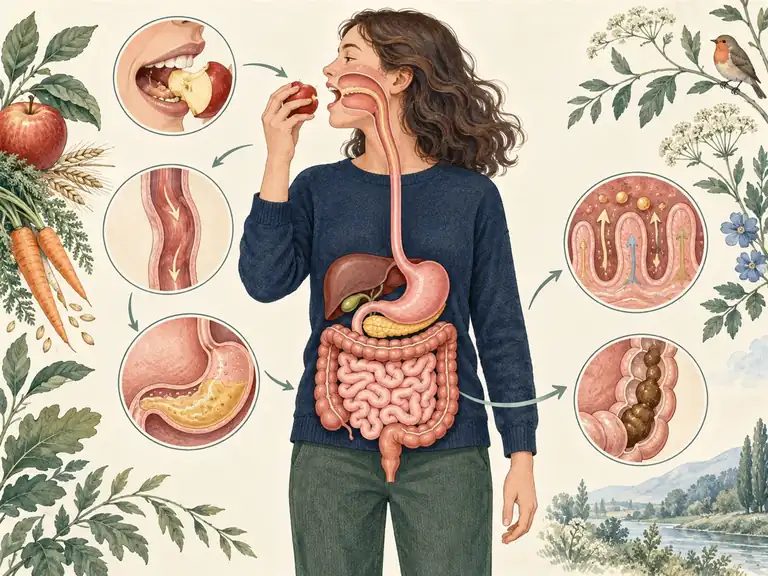
Digestion breaks food into molecules small enough to absorb and use. The tract runs from mouth to anus, while the liver, pancreas and gallbladder supply substances that support the process.
A journey with specialised stations
Chewing and saliva begin processing in the mouth. The oesophagus moves a swallowed portion by peristalsis. The stomach stores and mixes it with acid and enzymes.
Most chemical digestion and nutrient absorption take place in the small intestine. The large intestine absorbs water and houses a dense community of microbes; the rectum stores waste before elimination.
Helpers outside the tube
The pancreas releases digestive enzymes and bicarbonate into the small intestine. The liver makes bile, which helps with fats; the gallbladder stores and concentrates it.
Nerves, hormones, muscles, blood flow and gut microbes all participate. Digestion is not simply food falling through a pipe.
Sequence the route
- Write mouth, oesophagus, stomach, small intestine, large intestine, rectum.
- Put them in order.
- Add liver and pancreas beside—not inside—the main tube and label their contributions.