
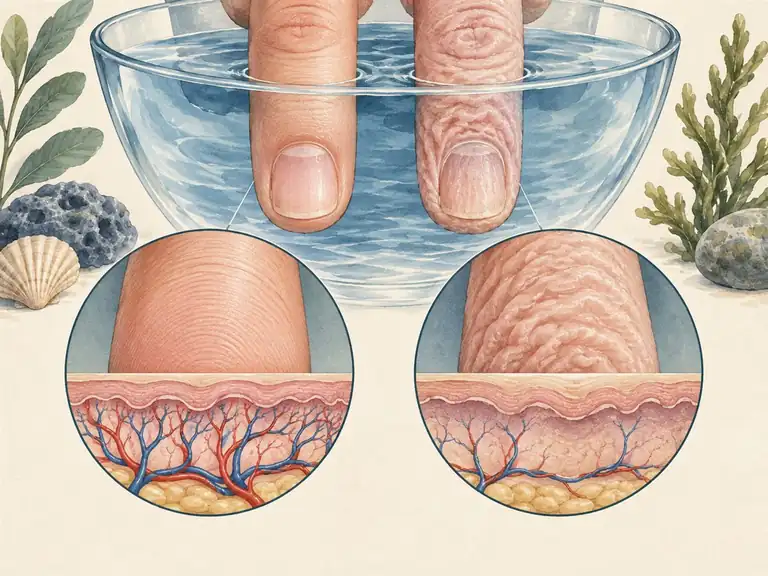
Long water exposure triggers sympathetic nerves to narrow blood vessels in finger and toe pads. The reduced tissue volume beneath the surface helps create folds in the overlying skin.
Evidence from circulation
Measurements show reduced blood-flow velocity during water-immersion wrinkling. Wrinkling is reduced when the relevant nerves are damaged, which is strong evidence that the response depends on the autonomic nervous system.
It happens especially on hairless, ridged skin of fingers and toes rather than equally across the body.
Does it improve grip?
A popular idea is that the grooves help handle wet objects, like tyre treads. Some experiments reported an advantage; others found no improvement in dexterity or touch. The mechanism is well supported, but its evolutionary benefit remains debated.
This is a useful example of science having different confidence levels: ‘how’ can be clearer than ‘why’.
Rank the evidence
- Write mechanism, observation and evolutionary explanation on three cards.
- Place vasoconstriction, finger-only pattern and better wet grip beneath them.
- Mark which claim has the strongest direct evidence.