
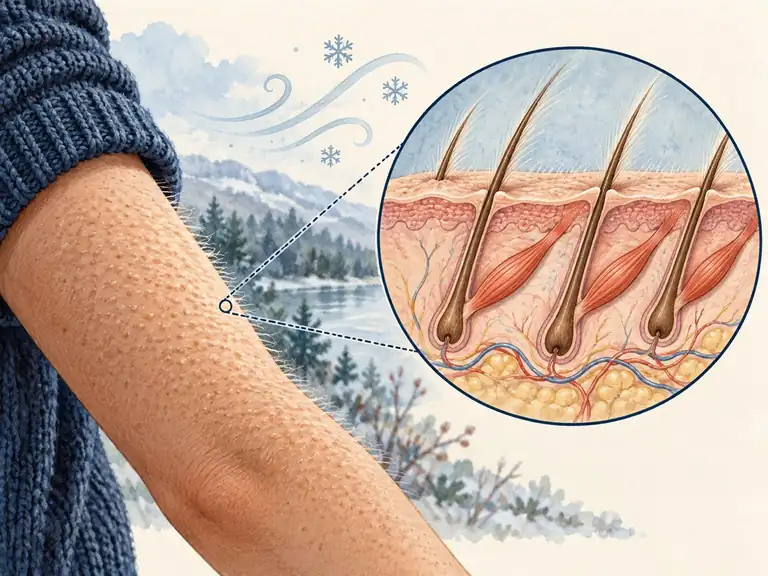
Goosebumps appear when arrector pili muscles attached to hair follicles contract. The sympathetic nervous system activates them during cold, fear and other intense emotions.
A skin-level movement
Each contracting muscle tugs on a follicle and dimples nearby skin, raising the hair. The same sympathetic system helps organise other automatic responses such as changes in skin blood flow.
In fur-covered animals, raised hair can trap insulating air or increase apparent size. Humans retain the mechanism even though our sparse body hair produces less of either effect.
A surprising stem-cell connection
NIH-supported research in mice found that the nerve, arrector pili muscle and hair-follicle stem-cell niche form a connected system. That work helps researchers study how environmental signals influence hair growth.
The finding does not mean a moment of goosebumps instantly grows new human hair. Animal and laboratory results must be described within their limits.
Compare the mechanism across animals
- Draw a human hair and a thick-furred animal hair.
- Show both raised by a tiny muscle.
- Explain why the same movement has different visible effects.