
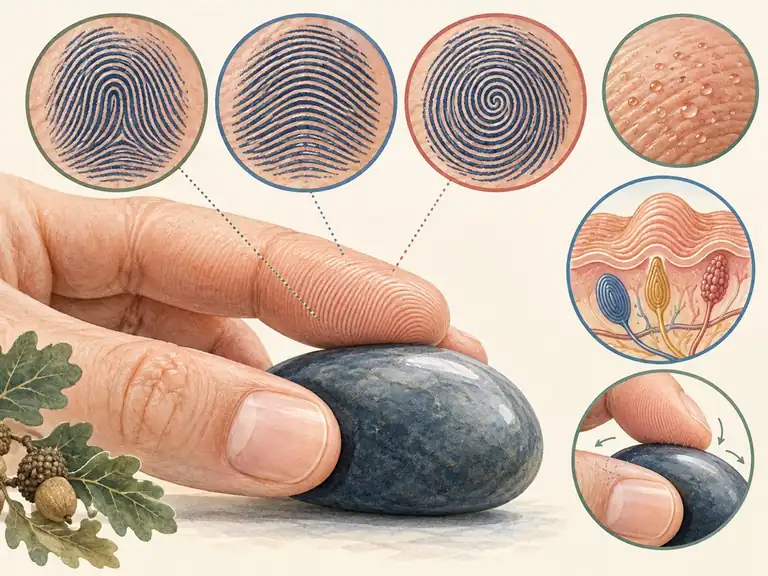
Fingerprints are friction ridges formed before birth on fingers, palms and soles. Their ridged structure helps regulate contact and moisture and is closely linked with fine touch receptors.
Useful ridges
Research shows that fingerprint ridges and sweat pores work together to keep fingertip moisture within a range that supports grip. Ridges also shape the tiny vibrations and mechanical events detected when a fingertip moves across a surface.
Touch receptors associated with individual ridges give nerve cells detailed subfields, helping the nervous system resolve fine spatial information.
Why patterns differ
Genes influence broad pattern types such as loops, arches and whorls, while local conditions during fetal development affect exact ridge paths and endings. Even identical twins therefore have different fine details.
Ridges usually persist because new surface cells follow the deeper structure. A deep injury can create a scar that changes the pattern.
Study patterns without collecting identity data
- Look at your own fingertip through a magnifier—do not ink or store prints.
- Sketch only a tiny imaginary example of a loop, arch and whorl.
- Label the sketch as a pattern study, not an identification record.