
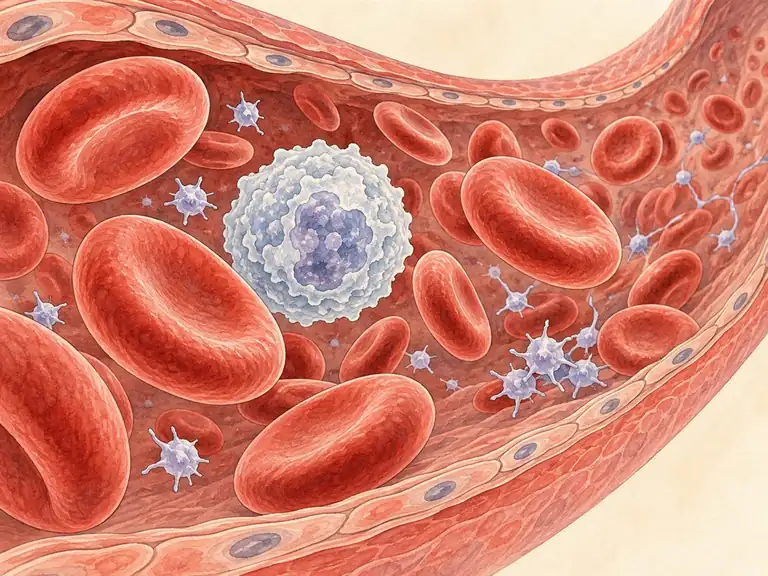
Blood is a living tissue made of cells suspended in plasma. It transports gases, nutrients, hormones and waste, helps defend against infection and forms clots after injury.
More than a red liquid
Red blood cells contain haemoglobin, which binds oxygen. White blood cells are part of immune defence. Platelets are cell fragments involved in clotting. Plasma is the liquid portion carrying these components and many dissolved substances.
Blood travels through arteries, capillaries and veins. In tiny capillaries, materials move between blood and nearby tissues.
Groups and compatibility
Red cells carry surface markers used to define blood groups, including ABO and Rh systems. A safe transfusion depends on matching and clinical testing because the immune system can react to unfamiliar markers.
It is misleading to call oxygen-poor blood blue. Veins may look blue through skin because light is absorbed and scattered; the blood inside is dark red.
Model the mixture
- Use four coloured counters for plasma, red cells, white cells and platelets.
- Give each colour a job label.
- Explain why removing any one component changes what blood can do.