
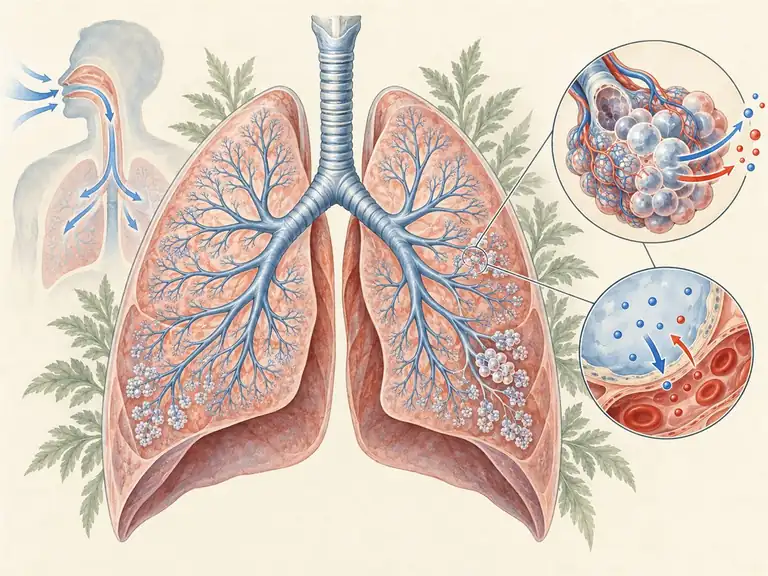
Lungs move oxygen into the blood and carbon dioxide out. Air travels through branching tubes to alveoli, where gases diffuse between air and capillary blood.
A branching design
Air enters through the nose or mouth, passes the larynx and trachea, then moves through bronchi and smaller bronchioles. These end in clusters of alveoli surrounded by capillaries.
The right lung has three lobes. The left has two and is slightly smaller because the heart occupies space on that side.
Breathing is a pressure change
The diaphragm contracts and moves down during inhalation, helping expand the chest so air flows in. During quiet exhalation it relaxes and elastic tissues help air flow out.
Alveoli are coated with surfactant, which reduces the work needed to inflate them. Their large combined surface supports rapid gas exchange.
Build a branching lung
- Draw one trunk line, two main branches and repeated smaller branches.
- Add grape-like alveoli at the ends.
- Draw capillaries around them and arrows for both gases.