
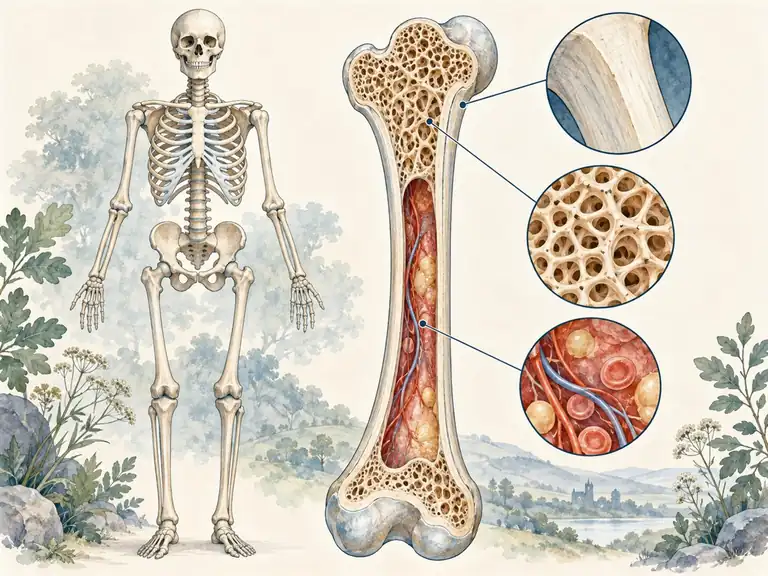
Bone is living tissue made from a collagen framework strengthened by minerals. It supports movement, protects organs, stores minerals and houses marrow that makes blood cells.
Structure at several scales
Compact bone forms a dense outer layer. Inside, trabecular or spongy bone forms a light lattice arranged along lines of stress. The periosteum covers much of the outside and contains nerves and blood vessels.
Collagen helps bone resist stretching, while calcium phosphate provides hardness. Strength comes from the combination, not from being completely solid.
Remodelling for life
Osteoclasts remove old bone and osteoblasts build new material; osteocytes help direct the process. Growth, movement, hormones, nutrition and age influence the balance.
The usual adult count is 206, but counts vary because some small bones fuse differently or extra bones occur. Babies have more separate elements that later join.
Engineer a light framework
- Roll paper into three tubes and stand them upright.
- Compare their load with three flat sheets.
- Relate the result cautiously to how shape can add strength without solid mass.