
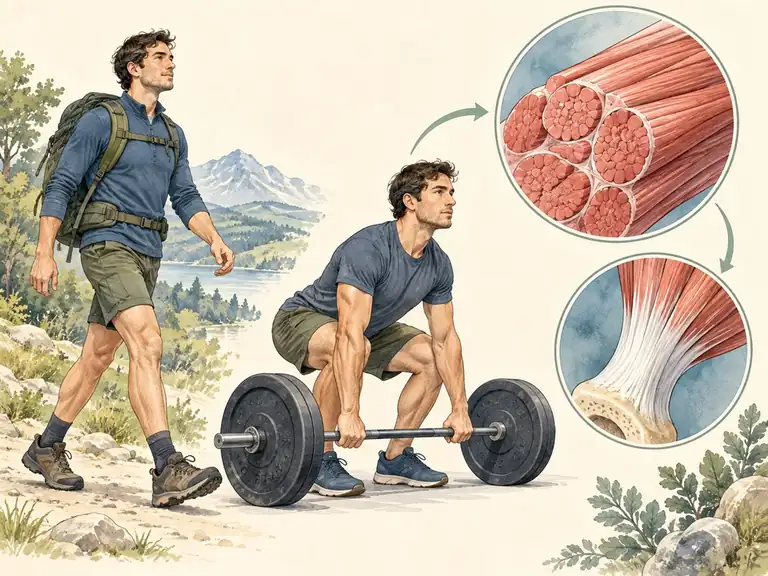
Muscle tissue produces force by contracting. Skeletal muscle moves bones, cardiac muscle pumps blood and smooth muscle moves or controls material inside organs and vessels.
Three muscle tissues
Skeletal muscles are attached to bones through tendons and are usually under voluntary control. Cardiac muscle forms the heart and contracts rhythmically. Smooth muscle in places such as the gut and blood vessels works largely without conscious control.
A skeletal muscle can pull when it contracts but cannot push itself longer. Muscles therefore work in co-ordinated groups, often with one action balancing another.
From signal to force
Motor nerves activate muscle fibres. Inside them, protein filaments slide past one another and shorten functional units called sarcomeres. Energy is required both for contraction and for restoring the system afterwards.
Training can improve strength, endurance or skill in different ways. Soreness is not a reliable score of workout quality, and pain is a reason to stop and seek appropriate advice.
Observe an opposing pair
- Slowly bend and straighten one elbow without a weight.
- Touch the upper-arm muscles gently.
- Notice that the pattern changes as one action reverses.