
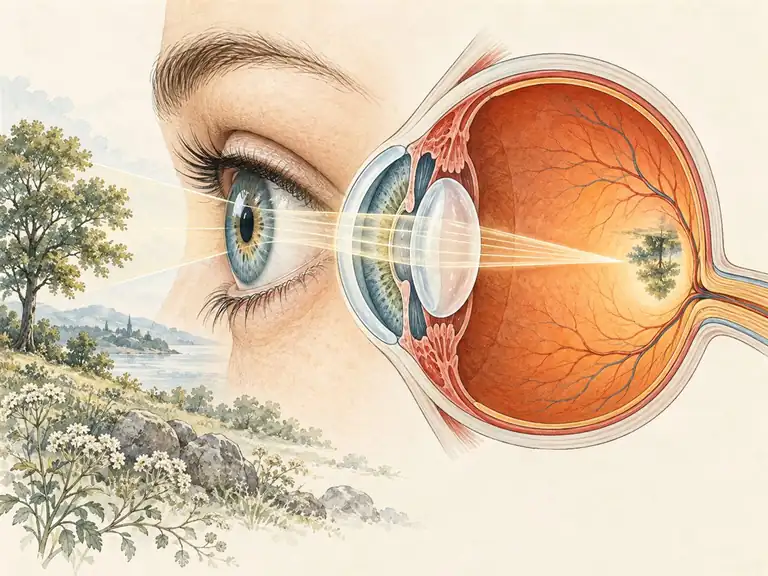
The eye focuses light onto the retina, where photoreceptors turn it into electrical signals. The optic nerve carries those signals to the brain, which constructs visual experience.
A pathway for light
The curved cornea begins most of the focusing. Light passes through the pupil, whose size is controlled by the iris, then through the lens. The lens changes shape to refine focus at different distances.
On the retina, rods are especially useful in dim conditions and cones support colour and fine detail in brighter light. Vision is weakest where the optic nerve leaves because there are no photoreceptors there.
Two eyes, one scene
Each eye sees from a slightly different position. The brain compares these images to help estimate depth, while also using motion, size and perspective cues.
Blinking spreads a three-layer tear film. Tears smooth the optical surface, nourish the cornea and help protect against irritants and infection.
Find the natural blind spot
- Draw a small cross and a dot about 10 cm apart.
- Close one eye and fix the other on the cross.
- Move the page slowly until the dot briefly disappears.