
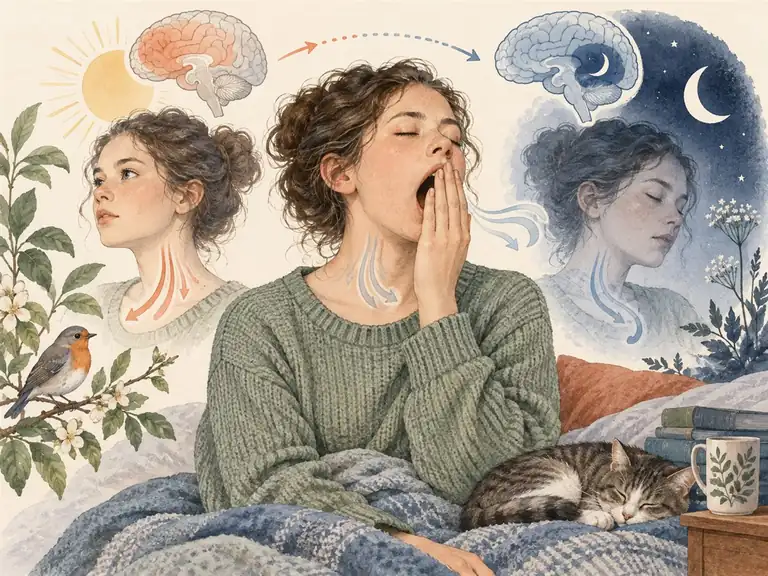
Yawning is a co-ordinated, involuntary pattern involving a wide mouth opening and deep breath. It is linked with transitions in alertness, but scientists have not agreed on one complete explanation for why it exists.
When yawns appear
Yawning is common after waking, before sleep and during monotonous situations. It also occurs in many other vertebrates. Seeing, hearing or even thinking about yawning can trigger it in some people.
The behaviour involves brainstem and higher brain networks, facial and breathing muscles, and changes in arousal. It is more than a simple request for extra oxygen; experiments do not support the old explanation that low oxygen is the main trigger.
Competing explanations
Proposals include shifting brain state, cooling, stretching muscles or communicating alertness within a group. Each explains some observations, but none is a final universal answer.
A good scientific account separates reliable observations—timing, sequence, contagion—from hypotheses about function.
Separate observation from hypothesis
- Write three things you can observe about a yawn.
- Then write two possible functions.
- Mark the functions as hypotheses rather than facts.